There are six main types of exhibition stands: shell scheme, pop-up displays, modular stands, custom-built stands, island stands and double-decker stands. Each one answers a different mix of budget, floor space and brand ambition. A pop-up works for a first show on a tight budget. A custom build works when you need to stand out in a busy hall and meet serious buyers.
The stakes are real. According to CEIR, about 67% of trade show attendees are entirely new prospects, buyers you have not reached through other channels. In this guide, you will learn how each stand type works, what it costs in euros and CFA francs, and how to pick the right format for your next show in West Africa.
TL;DR: the 30-second version
- Six main types: shell scheme, pop-up, modular, custom-built, island and double-decker.
- Cheapest: shell scheme and pop-up displays. Most impact: custom-built and island stands.
- Choose by goal, footprint, budget, number of shows per year and hall rules.
- Custom stands in West Africa start from about 600 € (XOF 393,600) per m², all taxes included.
- A booth and a stand are the same thing: "booth" is American English, "stand" is used in Europe and Africa.
What are the main types of exhibition stands?
The main types of exhibition stands fall into two families: reusable systems (shell scheme, pop-up, modular) and bespoke builds (custom, island, double-decker). Systems are faster and cheaper. Bespoke builds are designed around your brand and your goals. If you are new to the topic, start with our guide on what an exhibition stand is.
Here are the different types of exhibition stands you will meet on any trade show floor:
- Shell scheme stand: a basic booth supplied by the organiser, with white walls, a fascia board with your name, carpet and a spotlight or two. You add graphics and furniture.
- Pop-up display: a lightweight folding frame with a printed fabric or panel graphic. It sets up in minutes and fits in a carry case.
- Modular stand: a kit of aluminium frames and panels that you can reconfigure for different stand sizes and reuse across shows.
- Custom-built stand: a one-off structure designed and built for your brand, usually in timber, MDF, plywood and steel, with integrated lighting and screens.
- Island stand: a stand open on all four sides, often custom-built, placed in a high-traffic area of the hall.
- Double-decker stand: a two-level structure that adds a meeting or hospitality floor above the main exhibition area.
Stand position also matters. A row stand is open on one side, a corner stand on two, a peninsula stand on three and an island stand on four. More open sides means more visitors, but also more walls to design and finish.
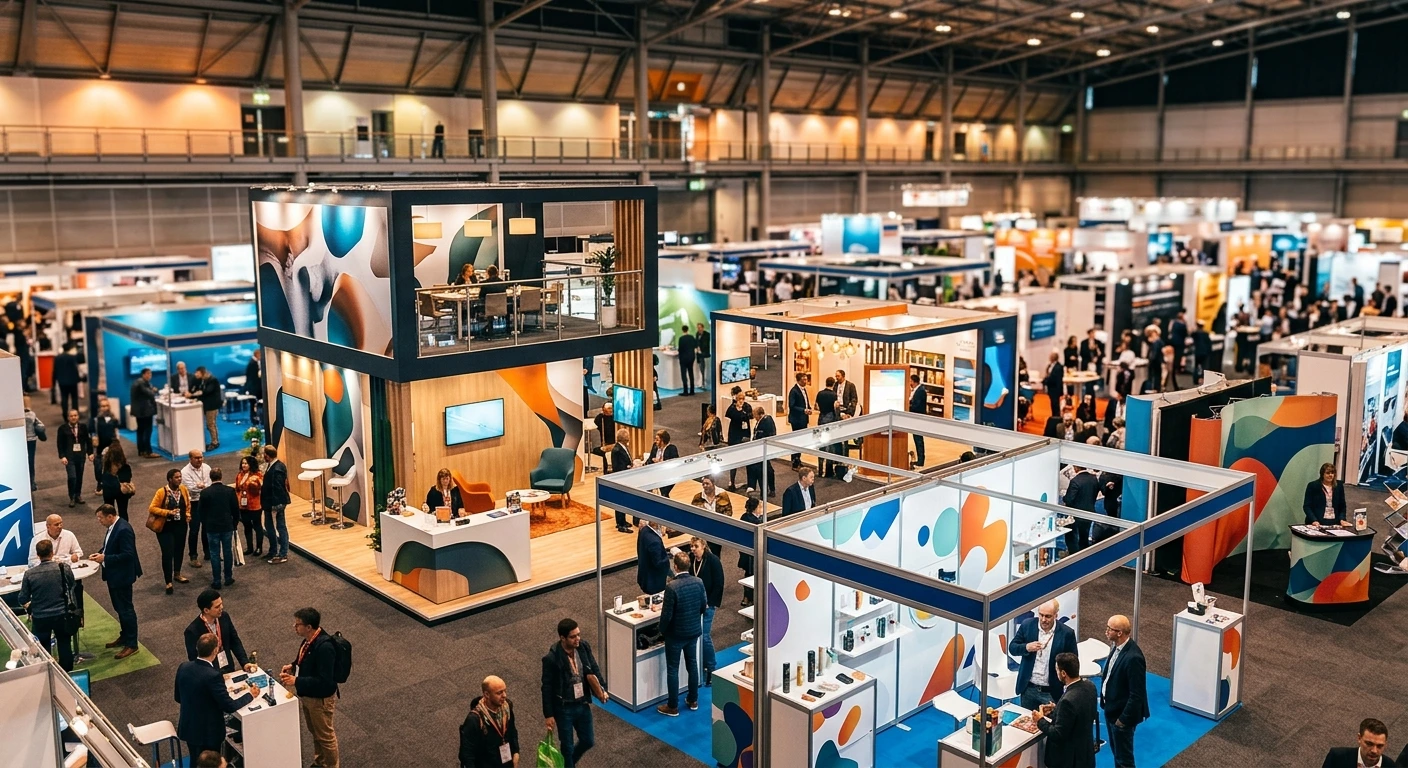
Comparison table: types of exhibition stands at a glance
| Stand type | Typical size | Relative cost | Brand impact | Best for |
|---|---|---|---|---|
| Shell scheme | 6 to 12 m² | Low | Low | First show, testing a market |
| Pop-up display | 3 to 9 m² | Low | Low to medium | Small events, conferences, lobbies |
| Modular | 9 to 36 m² | Medium | Medium | Many shows a year, standard look |
| Custom-built | 9 to 72 m² | Medium to high | High | Key shows, launches, premium brands |
| Island | 36 m² and more | High | Very high | Market leaders, sponsors |
| Double-decker | Large footprints | Very high | Very high | Hospitality, many meetings a day |
How to choose the right exhibition stand?
To choose the right exhibition stand, start from your goal, then check your footprint, your budget and how often you will reuse it. The stand type follows from those four answers, not the other way round.
Use this five-step method when choosing the right exhibition stand:
- Define one main goal. Lead generation, product launch, brand awareness or meetings with existing clients. A meeting-heavy stand needs closed spaces. A launch stand needs a hero display.
- Check your footprint and position. A 9 m² row stand and a 48 m² island stand call for very different formats.
- Set a realistic budget. Remember that the stand is only part of the bill. CEIR data shows that exhibit space alone takes roughly 40.5% of a typical trade show budget.
- Count your shows per year. One flagship show favours a custom build. Ten small shows favour a reusable system.
- Read the hall rules early. Height limits, rigging, fire-rated materials and build-up time can rule out some options.
Example: a bank exhibiting at one major show in Abidjan each year, with meetings all day, will get more from a custom stand with a closed meeting room. A start-up visiting four regional fairs will get more from a pop-up it can carry on a plane.
Before you sign with any builder, go through our five questions to ask a stand builder. They cover drawings, structural notes and what happens if the venue changes its rules.
Not sure which stand type fits your show?
Send us your show, dates and footprint. Our Abidjan studio replies within four working hours with a clear recommendation.
Get advice from a West African stand builderWhat are the advantages of modular stands?
The main advantages of modular stands are reusability, fast set-up and a lower cost per show when you exhibit often. The same kit can be rebuilt as a 9 m² row stand one month and an 18 m² corner stand the next.
The key benefits of modular stands:
- Reusable: frames and panels last for many shows, so the cost spreads over time.
- Flexible: you reconfigure the layout for different stand sizes.
- Quick to install: tool-free or low-tool assembly shortens build-up days.
- Easy to update: you only reprint the graphics when your message changes.
Modular exhibition stands also have limits. The look is often similar from one brand to the next. Shapes are constrained by the system. And storage, transport and repairs add costs between shows.
This is why Booth Smith made a clear choice: we build custom carpentry stands only. You can read why in the case for timber, and what we don't build. For West African exhibitors, local fabrication also removes cross-border freight, a hidden cost that often erodes the savings of a shipped modular kit.
What is the cost range for exhibition stands?
The cost of exhibition stands ranges from a few hundred euros for a pop-up display to tens of thousands of euros for a large custom or double-decker build. For custom stands in West Africa, a reliable benchmark is price per square metre.
At Booth Smith, custom builds start from 600 € per m² all taxes included (about XOF 393,600 per m²). That price covers design, fabrication, on-site installation and dismantling. Travel and venue fees are billed separately.
| Custom stand size | Starting price (EUR, incl. tax) | Starting price (XOF) |
|---|---|---|
| 9 m² | 5,400 € | ≈ 3.54 M |
| 12 m² | 7,200 € | ≈ 4.72 M |
| 18 m² | 10,800 € | ≈ 7.08 M |
| 36 m² | 21,600 € | ≈ 14.17 M |
Figures based on the 600 €/m² starting rate. Finish, country and timing adjust the final price.
What moves the exhibition stand cost up or down:
- Size and number of open sides: more walls and more finishes mean more material.
- Graphic finish: full printed graphics add about 60 € per m².
- Timing: a rush build adds around 15%.
- Technology: LED walls, screens and interactive demos.
- Structure: large spans and suspended elements need an engineer's sign-off.
Want the full breakdown? We open the books in what a 12 m² stand really costs, line by line. You can also run a live estimate with the quick price tool on the Booth Smith homepage.
Get your stand price in 10 seconds
Pick your size and country, see an indicative price in EUR and XOF, then get a firm quote within 48 hours.
Run a quick stand estimateWhat are pop-up displays and their benefits?
Pop-up displays are lightweight, collapsible stands made of a folding frame and a printed graphic that you can set up in minutes without tools. They are the entry point of the exhibition world.
The benefits of pop-up displays:
- Low cost: the most affordable way to have a branded presence.
- Portable: most models fit in one or two cases for air travel.
- Fast: one person can set up a pop-up in under half an hour.
- Versatile: useful in conferences, hotel lobbies, bank branches and roadshows.
The trade-off is impact. In a hall full of built stands, a pop-up can look small. It works best as a backdrop inside a shell scheme, or as a second stand at secondary events while your main custom stand covers your flagship show.
How do double-decker stands maximize space?
Double-decker stands maximize space by adding a second floor above your footprint, so you can almost double your usable area without paying for more floor space. The lower level stays open for visitors and demos. The upper level hosts meetings, VIP lounges or storage.
Double-decker stands benefits:
- More space on the same footprint: useful when floor space is expensive or sold out.
- Visibility: height makes the stand visible from across the hall.
- Private meeting areas: quiet space for negotiations away from the crowd.
They also demand more. Most venues require structural calculations, load tests, fire-safe staircases and advance approval. Build time and budget rise accordingly. Check the organiser's rules on height and upper floors before you commit. Any serious builder should sign off the structure on paper before a single panel is cut.
What is the difference between a booth and a stand?
There is no real difference between a booth and a stand: both describe the branded structure a company exhibits on at a trade show. "Booth" is the American term. "Stand" is used in Europe, Africa and the Commonwealth.
In practice, some people use "booth" for smaller, simpler set-ups and "stand" for larger built structures. But the terms are interchangeable in a brief or a quote. We cover the nuances in exhibition stand vs trade show booth.
Conclusion: which type of exhibition stand should you pick?
The right type of exhibition stand is the one that serves your main goal within your hall rules and budget. Key points to remember:
- Shell scheme and pop-up displays suit first shows and tight budgets.
- Modular stands suit frequent exhibitors who accept a standard look.
- Custom, island and double-decker stands deliver the strongest brand impact at key shows.
- In West Africa, custom stands start from about 600 € (XOF 393,600) per m², all taxes included.
Planning a show in Abidjan, Dakar, Accra or Lagos? Talk to Booth Smith, the custom exhibition stand builder for West Africa. Send your brief and get a response within four working hours.
Ready to build a stand that gets noticed?
Custom stands from 6 to 48 m², built by local teams in 8 West African countries. Indicative quote within 48 hours.
File your brief todayFAQ about types of exhibition stands
What is the most popular type of exhibition stand?
Shell scheme and modular stands are the most common by number, because they are affordable and quick. Custom-built stands dominate on high-value shows where brands compete for attention.
How long does it take to build a custom exhibition stand?
At Booth Smith, the standard lead time is about 14 to 18 days from signed brief to raise-day for a 12 m² stand, plus two days outside Ivory Coast.
Is a custom stand worth it for a small company?
Yes, if the show is strategic. A well-designed 9 or 12 m² custom stand can outperform a larger generic one. Start small, focus on one clear message and one strong visual.
Can I reuse a custom exhibition stand?
Often, yes. Many custom stands are designed so key elements can be stored and redeployed. Booth Smith runs an 820 m² warehouse and a kit re-deploy programme for returning clients.
Which stand type is best for a first trade show?
A shell scheme upgraded with good graphics, or a small custom stand of 9 m², gives the best balance of cost and impact for a first show.