TL;DR
An exhibition stand is a temporary, branded structure built at a trade show to attract visitors and generate leads.
- The three main formats are shell scheme, modular and custom-built, plus pop-up displays for small events.
- A good stand is visible from a distance, carries one clear message and gives visitors a reason to stay.
- Choose the format from your objective, budget, plot type and show frequency, not from looks alone.
- Custom carpentry stands in West Africa start around 600 € incl. tax per m² and deliver the strongest brand impact.
An exhibition stand is a temporary, branded structure that a company builds at a trade show to display its products, meet visitors and generate leads. Think of it as a pop-up showroom that lives for three to five days inside a busy hall.
Getting the stand right matters more than most exhibitors expect. Trade show research from 2026 shows that 58% of exhibitors now cite booth design as their number one way to attract attention on the floor, up from 41% in 2021.
In this guide you will learn what an exhibition stand is, the main types, what separates a good stand from a forgettable one, how to choose the right format for your budget and how assembly works. Let's start with the definition.
Ready to plan your next stand?
Turn your exhibition space into your strongest sales tool
Booth Smith designs, builds and installs custom exhibition stands across West Africa. Share your show details and we will send a free 3D concept and quote within a few working days.
Start my stand project Call +225 07 07 92 40 78
Design · 3D modelling · Fabrication · Installation and dismantling
What is an exhibition stand?
The meaning of an exhibition stand is simple: it is the physical space, plus everything built inside it, that represents your brand at an exhibition or trade fair. The floor space is rented from the organiser. The structure, graphics, furniture, lighting and screens are then designed, built and installed by the exhibitor or a stand builder.
A stand does three jobs at once:
-
Visibility: it makes your brand recognisable from across the hall.
-
Conversation: it gives your team a place to demo products and talk to prospects.
-
Memory: it leaves visitors with an impression that lasts after the show ends.
A 9 m² shell scheme with two roll-up banners is an exhibition stand. So is a 200 m² double-decker with a meeting lounge. What changes is the scale, the materials and the budget.
Why invest? Because the people walking past are unusually valuable. About 81% of trade show attendees have buying authority, and most of them are new prospects rather than existing customers.
How to design an exhibition stand?
To design an exhibition stand, start from your goals, then work backwards to the layout, the graphics and the materials. Most design mistakes come from doing this in reverse: picking a look first and hoping it will perform.
Here is the step-by-step process professional stand designers follow:
-
Set one measurable goal. "Collect 120 qualified leads" beats "get more visibility". Everything else in the design serves that number.
-
Confirm the space. Get the stand plan from the organiser: dimensions, open sides, height limit, position relative to entrances and aisles.
-
Decide the visitor flow. Where does someone enter? Where do they stop? Where do sales conversations happen? An open front with a clear focal point pulls people in.
-
Choose the format. Shell scheme, modular or custom-built (more on this below). Budget and reuse plans drive this decision.
-
Brief the designer. Share brand guidelines, products to display, number of staff, storage needs and any demo equipment.
-
Review the 3D render. A good stand builder will send a 3D model before anything is cut. Check sightlines, logo height and lighting.
-
Lock production and logistics. Approve materials, print files and delivery dates at least four to six weeks before the show.
A useful rule: every element on the stand should answer "what do I want a visitor to do next?" If it has no answer, cut it.
If you are exhibiting in Côte d'Ivoire or the wider region, working with a custom exhibition stand builder based in Abidjan removes the headache of shipping structures across borders and makes last-minute changes realistic.
What are the different types of exhibition stands?
There are three main types of exhibition stands: shell scheme, modular and custom-built. Pop-up displays are a fourth, lighter category used mainly for small events and roadshows.
|
Stand type |
What it is |
Best for |
Typical cost level |
Reusable? |
|
Shell scheme |
Standard aluminium frame and panels supplied by the organiser; you add graphics |
First-time exhibitors, small budgets |
Low |
Graphics only |
|
Pop-up stand |
Portable frame with printed fabric or panels, fits in a carry case |
Roadshows, conferences, small events |
Low |
Yes |
|
Modular stand |
System of interchangeable components (frames, walls, counters) reconfigured per event |
Companies exhibiting several times a year |
Medium |
Yes, many times |
|
Custom-built stand |
Bespoke structure designed and fabricated from scratch, often in timber or MDF, for a "space only" plot |
Product launches, brand statements, large plots |
High |
Usually single use, parts can be recovered |
A few practical notes on each:
-
Shell scheme stands are the safe entry point. You cannot change the structure, so impact depends on graphics and lighting.
-
Pop-up stands set up in minutes and travel easily, but struggle on a competitive trade show floor.
-
Modular stands cost more upfront than a shell scheme, but a system reused five times a year quickly pays for itself.
-
Custom-built stands give total freedom over shape, height and materials. They are the choice for a launch or a market entry.
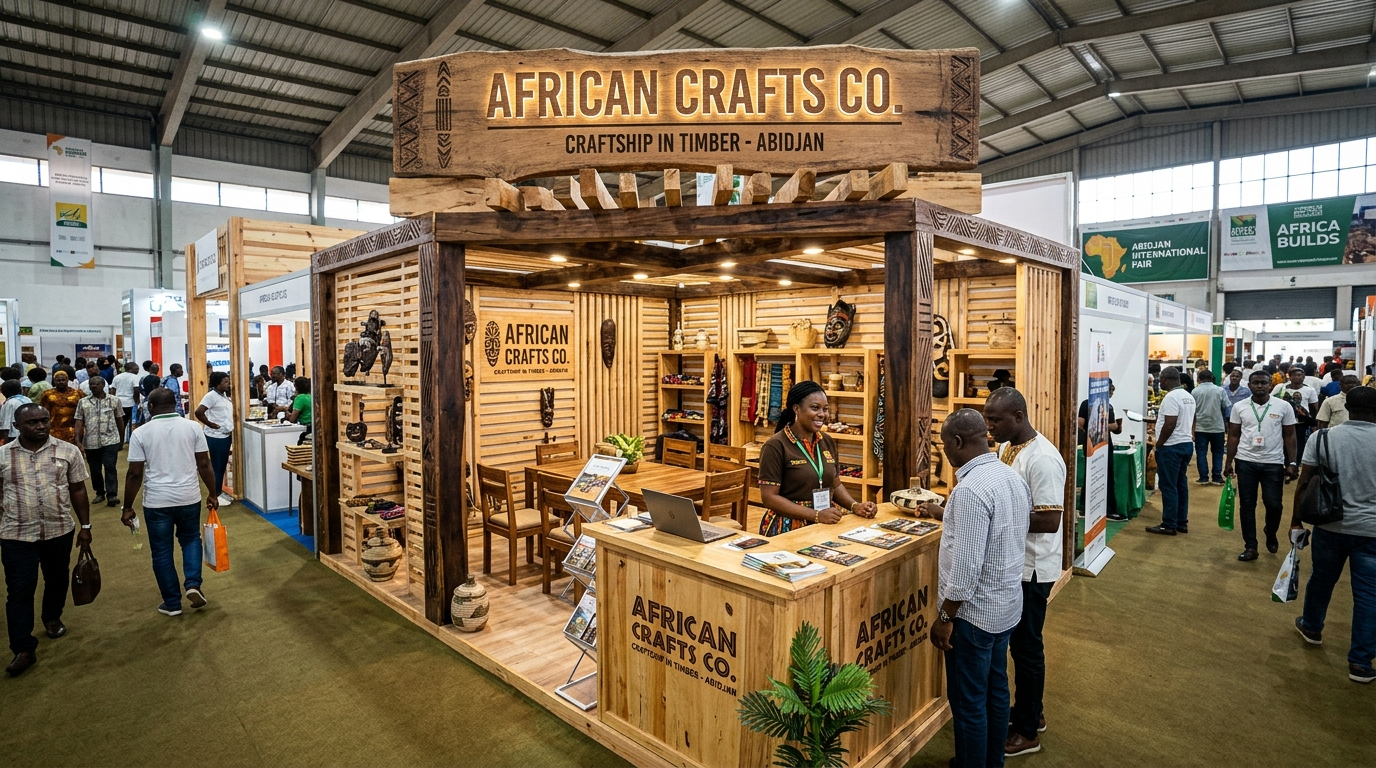
Custom carpentry stands in solid timber are gaining ground in West Africa because they photograph well, feel premium and can be produced locally rather than imported.
What makes a good exhibition stand?
A good exhibition stand is one that visitors notice, enter and remember, and that gives your team what it needs to convert conversations into business. High quality is not about spending the most. It is about removing every reason a visitor might walk past.
The five markers of a high-impact stand:
-
Visual impact from a distance. Your logo and headline should be readable from 10 metres. Height, contrast and lighting do most of the work here.
-
One clear message. Visitors decide in seconds whether you are relevant. A single benefit-led headline beats a wall of product photos.
-
An open, inviting layout. Closed fronts and counters at the entrance act as barriers. Keep the front open and place the reception desk to the side.
-
Brand visibility in every detail. Colours, materials and typography should match your other touchpoints so the stand feels like your brand, not a rented box.
-
A reason to stay. A live demo, a seating area, a coffee corner or an interactive screen turns a glance into a five-minute conversation.
Lasting impression is the test. After three days, visitors have seen hundreds of stands. They remember the ones with a distinct experience or a striking material, not the ones with the most features.
How to choose the right exhibition stand?
Choose the right exhibition stand by matching four things: your objective, your budget, your plot type and how often you exhibit. Once these are clear, the format usually chooses itself.
Ask yourself these questions:
-
What is the objective? Brand launch or market entry favours custom-built. Steady lead generation across many shows favours modular.
-
What is the budget per square metre? Shell scheme graphics can cost a few hundred euros in total. Custom carpentry stands in West Africa start around 600 € including tax per m², based on published rates from Booth Smith, and rise with complexity and height.
-
Is it a shell scheme or space only plot? Space only means you receive an empty floor area and must build everything, including walls and flooring. It gives freedom but adds cost and requirements such as structural approval.
-
How many shows this year? Exhibiting once justifies a bespoke build. Exhibiting six times justifies a modular system.
-
What are the venue requirements? Height limits, fire-rated materials, electrical certification and build-up windows all vary by venue. Check them before you design, not after.
Quick decision guide:
-
One show, big moment, healthy budget → custom-built
-
Several shows a year, consistent brand → modular
-
First show, tight budget → shell scheme with strong graphics
-
Small events and roadshows → pop-up
Median all-in exhibitor spend per show reached $32,400 in 2025 in the US, as companies concentrate on fewer, higher-impact shows. The lesson translates: one well-built stand at the right show beats three average ones.
What is the difference between a booth and an exhibition stand?
In everyday use, "booth" and "exhibition stand" mean the same thing: the space where a company exhibits. The difference is mostly regional, and sometimes about scale.
-
Booth is the standard term in North America. It often implies a smaller, standardised unit, such as a 10×10 ft shell scheme.
-
Exhibition stand is the standard term in the UK, Europe, Africa and much of Asia. It covers everything from a shell scheme to a large custom build.
Some suppliers use "booth" for compact, standardised setups and "stand" for larger custom spaces, but this is a convention, not a rule. When you brief a builder, describe the plot size, plot type and objective. Those details matter far more than the word.
How to assemble an exhibition stand?
Assembling an exhibition stand follows a fixed sequence: floor, structure, power, graphics, furniture, then testing. The method depends on the type of stand.
Pop-up stand setup (15 to 30 minutes):
-
Unfold the frame and lock the connectors.
-
Attach the magnetic bars or clip the fabric graphic.
-
Add lights and the counter, then check the print for creases.
Modular stand installation (half a day to one day):
-
Lay out components according to the numbered plan.
-
Assemble frames and connect wall panels.
-
Run cabling before closing panels.
-
Fit graphics, counters and screens.
-
Test every light and socket.
Custom-built stand installation (one to three days):
-
Confirm build-up access and deliver materials to the plot.
-
Lay flooring or the raised platform.
-
Erect walls, frames, rigging or ceiling.
-
Install electrics, lighting and audiovisual equipment.
-
Apply finishes and printed graphics.
-
Place furniture, products and signage.
-
Walk the stand as a visitor and fix anything that breaks the flow.
For custom builds, the stand builder's crew normally handles both assembly and dismantling. Confirm this in writing. If you are planning a stand in Abidjan, Dakar, Accra or Lagos, a stand fabrication and installation partner serving eight West African countries will manage build-up and breakdown so your team only has to show up.
Resume
An exhibition stand is far more than a rented square in a hall. Here is what to keep in mind:
-
Definition: a branded, temporary structure built to attract, engage and convert visitors at a trade show.
-
Types: shell scheme, pop-up, modular and custom-built, each with a different balance of cost, reuse and impact.
-
Quality: visibility from a distance, one clear message, an open layout, consistent branding and a reason to stay.
-
Choice: match your objective, budget, plot type and show frequency.
-
Assembly: floor, structure, power, graphics, furniture, test.
Get this right and the stand becomes the marketing asset your best prospects physically walk into.
FAQ
What does an exhibition stand cost?
It depends on the type. Shell scheme graphics can cost a few hundred euros. Modular stands run to a few thousand. Custom carpentry stands in West Africa start around 600 € including tax per m², with final pricing driven by size, height, finishes and audiovisual equipment.
How far in advance should I book a stand builder?
Aim for eight to twelve weeks before the show for a custom build. This leaves time for design, 3D approval, fabrication and venue paperwork. Modular and pop-up stands can be arranged in three to four weeks.
Can I reuse a custom-built exhibition stand?
`Partly. Elements such as counters, furniture, lighting and some panels can be stored and reused. Fully bespoke walls and structures are usually built for a single show, which is why frequent exhibitors often prefer modular systems.
Is a shell scheme included in the plot price?
Usually yes. Organisers offer shell scheme packages (walls, name board, basic lighting) with the space, while space only plots are cheaper per m² but require you to build everything.